The Problem: Driving Until the Tank Is Empty
Most truckers do not plan their stops. They drive until the fuel gauge blinks, then pull into the nearest station. Or they realize they have been behind the wheel for five hours and need a rest stop now - but the next exit is twenty miles away and the only option is a cramped shoulder with no facilities.
This is not laziness. It is a lack of information. A trucker looking at a standard GPS sees a blue line to the destination. What they do not see is where they can actually stop along that line without violating hours-of-service rules, running out of diesel, or ending up at a station that cannot accommodate a fifty-three-foot trailer.
That is where isochrones change the game.
What Is an Isochrone, Really?
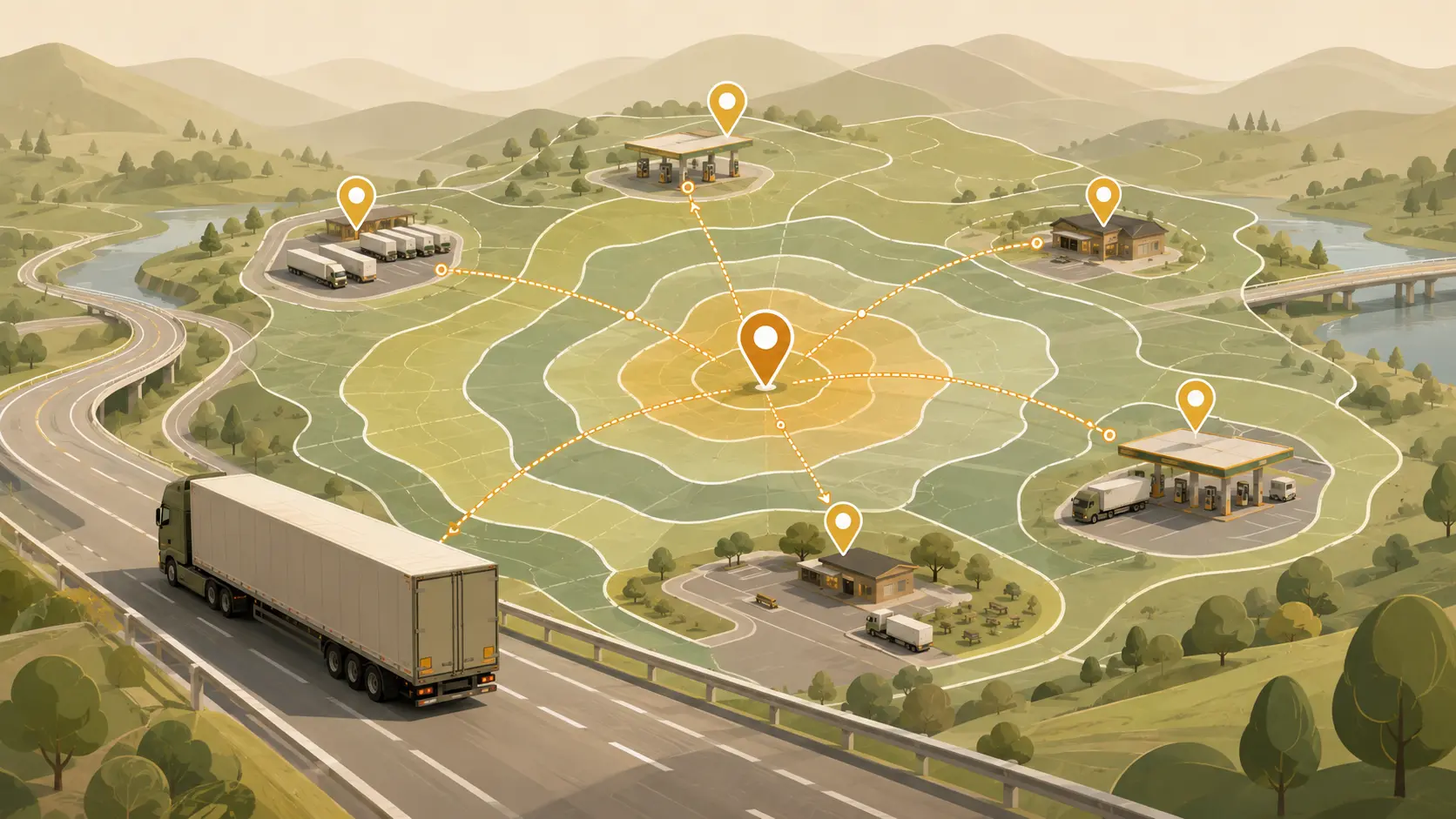
An isochrone is a shape on a map showing every reachable point from a starting location within a given travel time. Think of it as a bubble that expands outward based on how far a vehicle can travel in, say, thirty minutes, one hour, or four hours.
Unlike a simple radius circle, an isochrone respects roads, speed limits, traffic patterns, and vehicle type. A thirty-minute isochrone for a truck on a highway looks very different from a thirty-minute isochrone for a car in a city center. The truck’s bubble stretches farther along the interstate but shrinks near urban centers with low-speed zones and weight-restricted roads.
For a trucker, an isochrone answers a specific question: “If I keep driving at my current pace, where will I be in two hours? And what stops are inside that zone?”
The Regulatory Reality: Why Timing Matters
In the United States, the Federal Motor Carrier Safety Administration (FMCSA) enforces strict hours-of-service (HOS) regulations. A trucker can drive a maximum of eleven hours after ten consecutive hours off duty. They must take a thirty-minute break after eight cumulative hours of driving. There are also weekly limits and sleeper berth provisions that make scheduling a puzzle.
Violating these rules is expensive. Fines range from hundreds to thousands of dollars per occurrence. Repeat violations can put a driver out of service or trigger audits for the entire fleet. In 2023, HOS violations accounted for over 16% of all roadside inspection violations nationwide.
European regulations under Regulation (EC) No 561/2006 are similarly strict, with mandatory breaks after four and a half hours of driving and daily driving limits of nine hours.
The challenge is not just knowing the rules. It is knowing where to be when the clock runs out. A driver cannot simply stop anywhere. They need:
- Adequate parking for a long-haul truck
- Fuel availability
- Safe surroundings, especially for overnight stops
- Amenities like food, restrooms, and showers
- Sometimes, secure facilities for high-value cargo
An isochrone layer that filters for truck-friendly stops and overlays HOS countdown timers turns route planning from guesswork into precision logistics.
Use Case 1: The Mandatory Thirty-Minute Break
Scenario
A driver named Marcus is hauling refrigerated produce from Salinas, California to Phoenix, Arizona. He started his shift at 6:00 AM. By 1:45 PM, he has been driving for seven hours and forty-five minutes. He needs a thirty-minute break before the eighth hour.
Without Isochrones
Marcus watches the clock and hopes the next exit has a suitable stop. He takes Exit 168, drives two miles off the interstate, and finds a gas station with a single cramped parking space between two pumps. He blocks traffic to squeeze in, buys a sandwich, and spends twenty minutes stressed about whether he will get a ticket for parking there. He leaves without a proper rest.
With Isochrones
Marcus’s dispatch system generated a four-hour isochrone at the start of his route. Inside that bubble, the system identified three truck stops with verified parking, one with a diner and showers. The system also flagged a two-hour isochrone from his current position at 11:30 AM, showing that only one of those three stops would still be reachable before his eighth hour.
At 11:15 AM, Marcus gets a heads-up: “Break window opens in 45 minutes. Recommended stop: TA Travel Center, Exit 156. 120 truck spaces, diesel price $3.89, diner open.” He pulls in at 1:50 PM, parks in a designated space, eats a proper meal, showers, and resumes driving at 2:20 PM - compliant, rested, and on schedule.
Use Case 2: Fuel Range Anxiety at Scale
Scenario
A freight company operates a fleet of two hundred trucks across the Midwest. Each truck averages six and a half miles per gallon and carries two hundred gallons of diesel - a theoretical range of thirteen hundred miles. In reality, fuel stops are planned every six hundred miles to maintain a safety buffer, account for detours, and optimize for fuel prices.
Without Isochrones
Dispatchers manually map fuel stops using spreadsheets and generic mapping tools. They assume stations near the route are suitable. A driver arrives at a planned stop only to find the diesel pumps are on the wrong side of a tight lot, the station does not accept the fleet fuel card, or the price is twenty cents higher than expected. The driver either pays the premium or deviates from the route, burning extra fuel and time to find an alternative.
With Isochrones
The fleet management system generates isochrones at six-hundred-mile intervals along each route. It filters for stations that:
- Accept the fleet fuel card (WEX, FleetCor, etc.)
- Have high-flow diesel pumps designed for trucks
- Offer the best price within the isochrone zone
- Have verified truck parking and safe ingress/egress
- Are reachable before the fuel reserve drops below fifty gallons
The system also generates overlapping isochrones to show alternative options. If the primary station is closed or congested, the driver has two backups within the same fuel window, all pre-approved by dispatch.
For a fleet of two hundred trucks, optimizing fuel stops across a six-hundred-mile corridor saves an estimated $12,000 per month in fuel cost variance alone. That does not include the savings from reduced detours, faster refueling, and fewer out-of-network fuel card fees.
Use Case 3: The Overnight Dilemma
Scenario
A driver named Elena is hauling auto parts from Detroit to Atlanta. She is eleven hours into her drive and must stop for the night. She is currently on I-75 near Chattanooga, Tennessee. She needs a safe place to park, sleep in her sleeper berth, and resume driving at 6:00 AM.
Without Isochrones
Elena uses a generic truck stop app that shows locations but not whether they have parking available right now. She drives to the first major chain, finds the lot full, and loops to a second. By the time she finds a space, she has burned forty-five minutes of her remaining drive time and is parked at a poorly lit facility with no security. She sleeps poorly, worried about cargo theft, and starts the next day fatigued.
With Isochrones
At 7:00 PM, Elena’s system generates a three-hour isochrone from her current position. It overlays real-time parking availability data from truck stop networks and weighs factors like:
- Security (lighting, fencing, camera coverage)
- Amenities (showers, laundry, Wi-Fi)
- Proximity to her optimal morning departure point
- Historical safety ratings from other drivers
- Cost (some fleets negotiate discounted parking rates)
The system recommends a secure facility twenty minutes ahead with guaranteed reserved parking, a hot meal available until 10:00 PM, and a shower. Elena books the spot via the app, arrives by 8:00 PM, and gets ten hours of quality rest. She departs at 6:00 AM sharp, hitting her delivery window with time to spare.
Use Case 4: Coordinating Team Hauls
Scenario
A heavy-haul company moves oversized wind turbine blades across Texas. The move requires two pilot cars, a lead escort, and a rear escort, plus the main truck. All four vehicles must stop simultaneously for breaks and fuel because the convoy cannot split on narrow rural roads.
Without Isochrones
The convoy coordinator calls each driver on the radio to coordinate stops. The lead pilot finds a suitable station, but the rear escort is five miles back with a different fuel level. The main truck needs a break in twenty minutes, but the only station with adequate space is forty minutes ahead. The convoy either splits (risky and illegal in some jurisdictions) or some drivers take breaks late, violating HOS rules.
With Isochrones
The fleet system generates synchronized isochrones for all four vehicles, accounting for their different speeds and fuel consumption rates. It finds the intersection of all four isochrones - locations reachable by every vehicle within their respective fuel and break windows.
At 10:00 AM, the system identifies a single truck stop reachable by all four vehicles within the next ninety minutes. The lead pilot confirms the route is clear. The convoy stops together, refuels, and takes a synchronized thirty-minute break. No radio chaos, no violations, no split convoy.
Use Case 5: Dynamic Replanning After Delays
Scenario
A driver named Jamal is hauling electronics from Seattle to Denver. A snowstorm closes I-80 through Wyoming. His planned fuel stop and overnight rest point are now unreachable. He is rerouted south through I-70, adding two hundred miles to his trip.
Without Isochrones
Jamal pulls over, calls dispatch, and waits for a new plan. Dispatch manually searches for stops along the new route. By the time a plan is ready, Jamal has lost an hour. He drives into the night, misses his preferred overnight stop, and ends up at a marginal facility with no parking. The next morning, he is behind schedule and fatigued.
With Isochrones
The moment the reroute is confirmed, the system generates new isochrones along I-70. It recalculates fuel windows based on the longer distance and higher elevation (which burns more fuel). It identifies a new fuel stop in Grand Junction, Colorado, and an overnight facility in Glenwood Springs - both reachable within Jamal’s remaining HOS hours and fuel range.
Jamal gets the updated plan before he even reaches the detour point. He stops in Grand Junction for fuel, reaches Glenwood Springs by 8:00 PM, and sleeps in a reserved spot. He is back on the road at 6:00 AM, still on schedule for his Denver delivery.
What Makes a Good Trucking Isochrone
Not all isochrones are equal. A consumer-grade isochrone built for cars will mislead truckers. Here is what matters:
Vehicle Profile Accuracy
Truck isochrones must account for:
- Speed limits: Trucks often have lower speed limits than cars, especially on highways and in urban areas.
- Weight restrictions: Some bridges and roads prohibit heavy trucks, forcing detours.
- Hazardous materials routing: Certain roads restrict HAZMAT cargo, requiring specialized pathfinding.
- Turn restrictions: Trucks need wider turning radii; some intersections are impassable.
- Elevation: Climbing burns more fuel and reduces average speed; descents require different braking patterns.
A forty-five-minute isochrone for a car on a flat interstate might cover sixty miles. For a fully loaded truck climbing a mountain grade, it might cover only forty-five.
Stop Suitability Filtering
Truck stops are not gas stations. A good isochrone engine filters for:
- Parking capacity: Number of spaces, length of spaces, and real-time availability.
- Fuel type: Diesel, DEF (diesel exhaust fluid), and sometimes CNG or hydrogen.
- Payment networks: WEX, FleetCor, Comdata, and proprietary fleet cards.
- Amenities: Showers, laundry, Wi-Fi, repair services, and load boards.
- Security: Lighting, fencing, cameras, and on-site staff.
- Ingress/egress: Can a fifty-three-foot trailer enter and exit without reversing or tight maneuvers?
Temporal Awareness
A stop that is perfect at 2:00 PM might be full at 8:00 PM. Isochrones should integrate:
- Real-time parking availability from truck stop networks
- Historical congestion patterns (e.g., Friday evenings near distribution hubs)
- Seasonal variations (harvest season, holiday shipping surges)
- Weather impacts on road conditions and stop accessibility
Multi-Constraint Optimization
The best systems do not just show one isochrone. They layer multiple constraints:
- Fuel isochrone: Where can I reach before my tank hits 25%?
- HOS isochrone: Where can I reach before my driving window closes?
- Break isochrone: Where can I reach before I need a mandatory thirty-minute break?
- Delivery isochrone: Where can I reach and still make my delivery window?
The intersection of these shapes - the overlapping zone where all constraints are satisfied - is where the optimal stop lives.
Building It: What Developers Need to Know
If you are building route planning software for trucking, here is how to integrate isochrones effectively.
1. Start with the Right Data
You need road network data that includes truck-specific attributes. OpenStreetMap has some truck tagging, but commercial datasets like TomTom MultiNet or HERE HD Map offer more comprehensive coverage of weight limits, height clearances, and HAZMAT restrictions.
For fuel and stop data, integrate with truck stop networks (Love’s, TA/Petro, Pilot Flying J) and payment networks (WEX, FleetCor) for real-time pricing and availability. Some fleets also maintain private stop databases with negotiated rates.
2. Choose Your Isochrone Engine
You have three options:
- Build your own: Use open-source routing engines like Valhalla or OpenRouteService. You get full control but invest heavily in infrastructure and data maintenance.
- Use a commercial API: Mapbox, HERE, and Google offer isochrone APIs, but truck-specific profiles vary in quality and cost scales aggressively with volume.
- Specialized logistics APIs: Platforms like Farun provide isochrones built for commercial vehicles with offline capabilities - useful for routes through areas with poor connectivity.
3. Model the Vehicle Profile
Do not assume one truck profile fits all. A dry van hauling paper towels behaves differently from a refrigerated unit hauling frozen meat or a flatbed carrying steel beams. Weight, dimensions, and cargo type all affect routing, speed, and fuel consumption.
Allow dispatchers to configure vehicle profiles per truck or per load. The isochrone engine should accept parameters like:
- Gross vehicle weight
- Trailer length and height
- Axle count and spacing
- Cargo type (including HAZMAT classifications)
- Fuel capacity and current fuel level
- Driver HOS status (remaining drive time, break windows)
4. Precompute Where Possible
Isochrones are computationally expensive. For fixed routes - like a weekly milk run from a distribution center to a set of stores - precompute isochrones for each segment. Store them and update them when road conditions change or new stops are added.
For dynamic routes, compute isochrones on demand but cache results for common origin points and time windows. A distribution center in Chicago will generate similar isochrones every morning; there is no need to recalculate from scratch each time.
5. Present It Simply
Truckers do not need to see the math. They need clear, actionable information:
- “Next break due in 47 minutes. Three stops available. Recommended: Exit 156, TA Travel Center, 2.3 miles ahead.”
- “Fuel range: 189 miles. Next fuel stop: Exit 203, Love’s, 167 miles. Alternative: Exit 198, Pilot, 142 miles (higher price).”
- “Overnight stop required in 3 hours 12 minutes. Two facilities with parking available. Reserve now?”
The isochrone shape itself is useful for dispatchers and planners. Drivers need the distilled recommendation.
The Bigger Picture: Isochrones as Infrastructure
Isochrones are not just a feature. They are infrastructure for modern logistics. As supply chains become more complex - with tighter delivery windows, stricter regulations, and higher fuel costs - the ability to predict where a vehicle can be at a specific time becomes a competitive advantage.
For trucking specifically, isochrones solve three systemic problems:
- Compliance automation: Removing the mental load of HOS tracking from drivers, reducing violations and fatigue.
- Cost optimization: Finding the cheapest fuel, the most efficient stops, and the least detour-prone routes.
- Driver retention: Better stops mean better rest, safer parking, and less stress. In an industry facing a chronic driver shortage, quality of life matters.
The companies that get this right will not just move freight faster. They will move it smarter, safer, and more sustainably than the ones still driving until the tank is empty.
Quick Reference: Isochrone Parameters for Trucking
| Parameter | Why It Matters | Example Value |
|---|---|---|
| Max driving time | HOS compliance | 11 hours (US) / 9 hours (EU) |
| Break window | Mandatory rest intervals | 30 min after 8 hours (US) |
| Fuel range | Tank capacity minus reserve | 600 miles at 80% capacity |
| Vehicle weight | Road restrictions, speed limits | 80,000 lbs (US interstate) |
| Trailer dimensions | Bridge clearances, turn radius | 53 ft length, 13.5 ft height |
| Cargo type | HAZMAT routing, speed restrictions | Refrigerated, non-HAZMAT |
| Preferred stop brands | Fleet fuel card networks | WEX, FleetCor, proprietary |
| Parking requirements | Minimum space length, security | 60 ft space, lit, fenced |
| Time of day | Real-time availability, amenities | 8:00 PM arrival, diner open until 10 |
Farun builds location infrastructure for teams operating beyond reliable connectivity. Our isochrone APIs support truck-specific routing, offline computation, and real-time stop filtering. If you are building fleet software, get in touch.