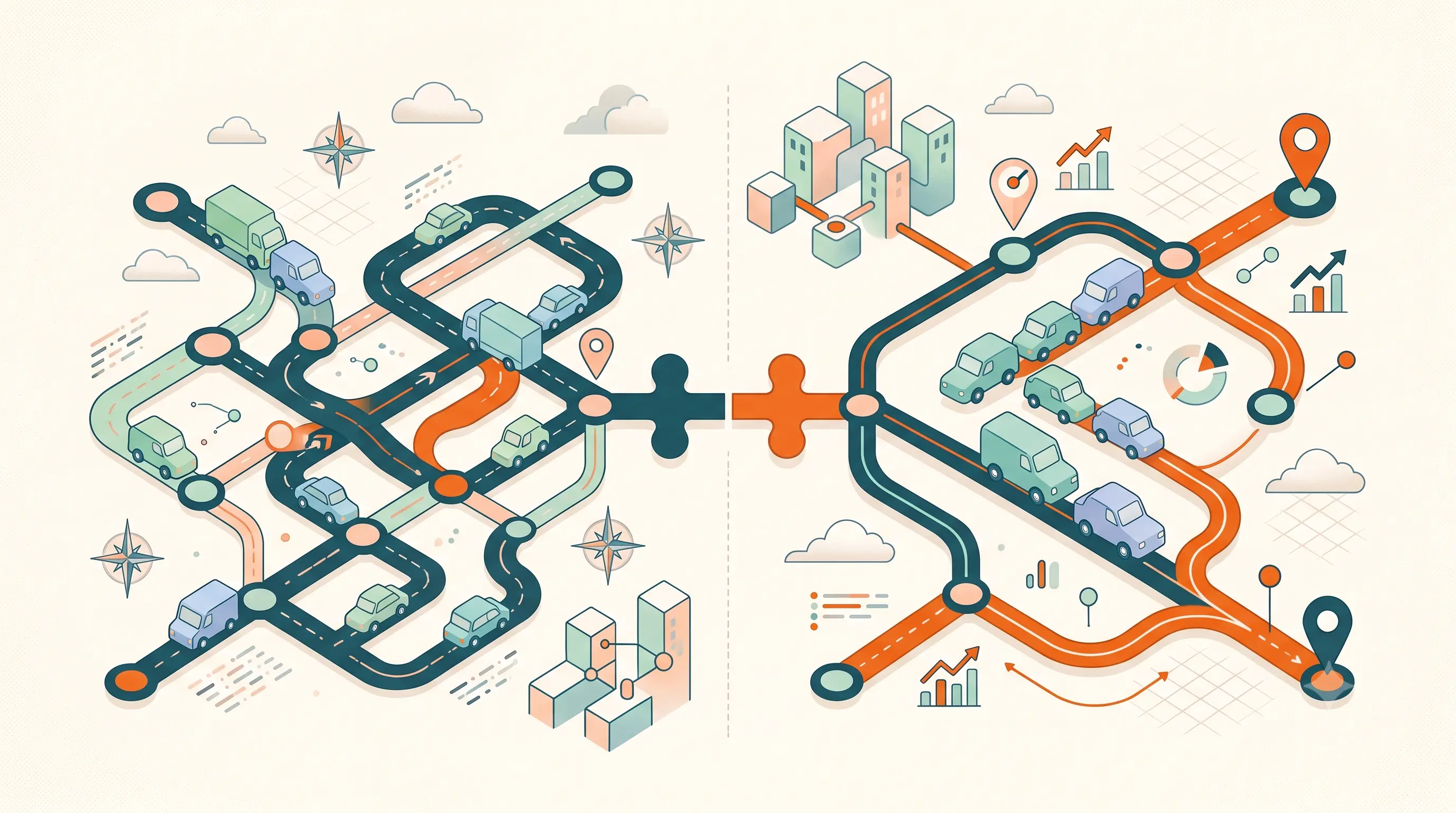
Standard routing finds one path between two fixed points. Route optimization decides the best order to visit several stops before routing each leg. Picking the wrong one wastes either developer time, by over-engineering a single delivery, or fuel and driver hours, by under-engineering a 15-stop run. The distinction matters because standard routing and route optimization solve two different problems, yet their names sound similar enough that teams often choose the wrong API endpoint for the job.
This article covers the definitions, the math behind each, when to use which, and how the two capabilities combine in a real dispatch workflow. A normal routing engine handles single-leg directions. An Optimized Route API solves multi-stop sequencing. By the end, you will know exactly which endpoint to call for a ride-hailing trip, a 12-stop delivery run, or a field-service dispatch board.
What Is Standard Routing?
Standard routing is the calculation of a single path between a fixed start point and a fixed end point, using real road data such as one-way streets and turn restrictions. It returns turn-by-turn directions, distance, and estimated travel time for one trip, not the order of multiple stops.
Standard routing answers the question “how do I get from A to B.” It does not answer “in what order should I visit A, B, C, and D.” A standard routing engine calculates this in a single request.
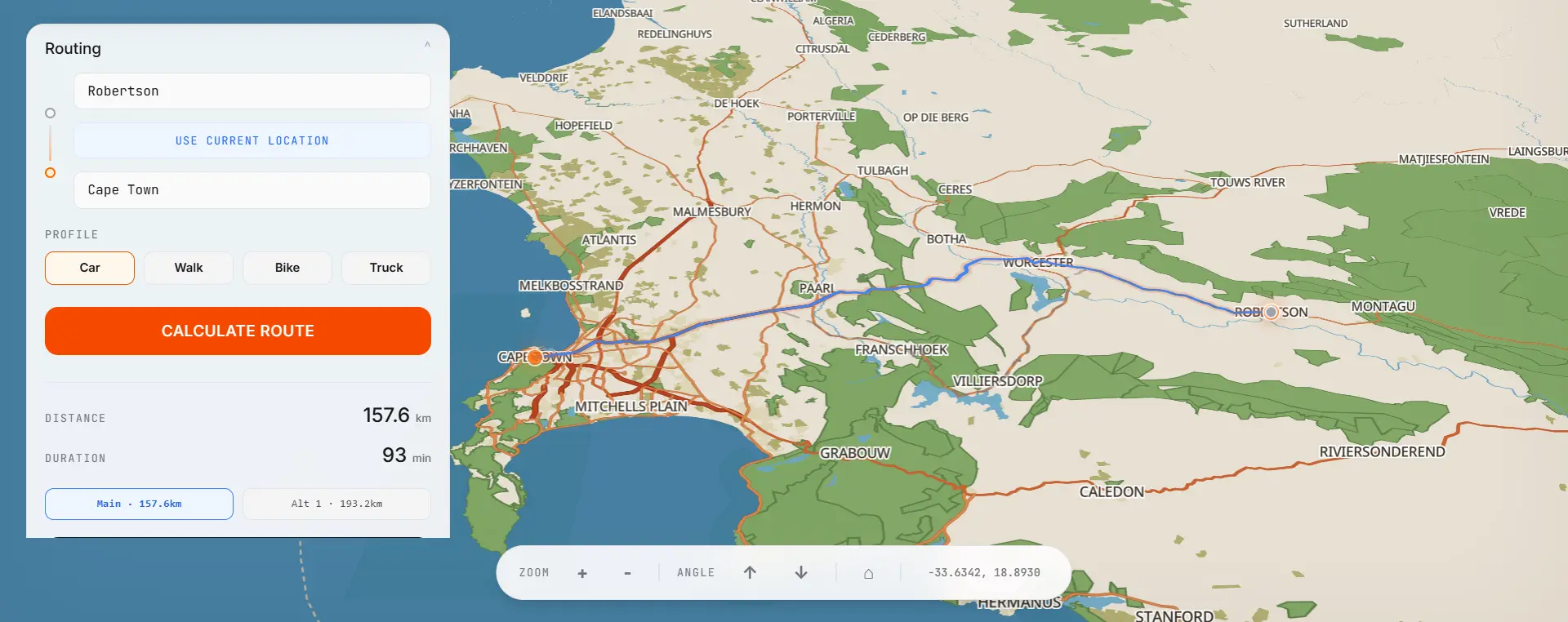
You can include waypoints along a fixed path, but the engine will not reorder them. The sequence you send is the sequence it routes. The output typically includes distance, duration, and step-by-step instructions.
Common uses include a single delivery, a driver app showing directions to one destination, or a “get directions” button on a store locator. Most standard routing engines are built on open road data from OpenStreetMap, a global map dataset maintained by a community of contributors.
What Is Route Optimization?
Route optimization is the process of finding the best order to visit multiple stops so total travel time or distance is minimized, then generating the route for that sequence. It answers a sequencing problem first and a directions problem second.
Route optimization takes an unordered list of stops and returns the most efficient visiting order. An Optimized Route API solves this by testing possible stop sequences against the real road network, not just straight-line distance.
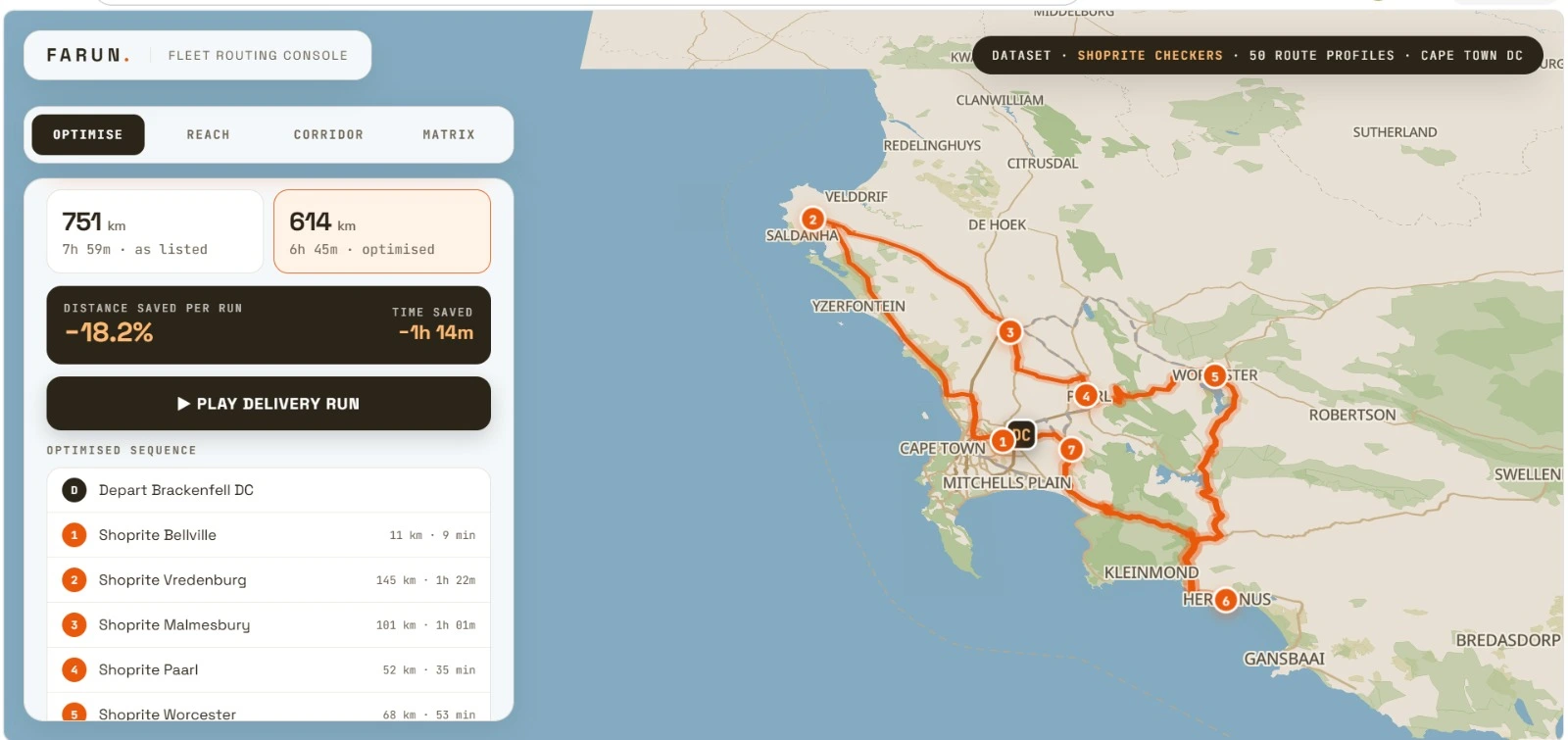
The process typically also returns the routed geometry for the optimized sequence. That means it handles sequencing and routing in one step. Constraints like time windows, vehicle type, and return-to-depot rules shape the final result.
Example uses include a delivery driver with 12 stops in one shift, or a field technician visiting six job sites. For a visual overview of how this works in logistics, see this AI route optimization explainer video.
What Is the Core Difference Between Route Optimization and Standard Routing?
The core difference is what each one decides. Standard routing decides the path for a fixed sequence of points. Route optimization decides the sequence itself, then routes it. Standard routing solves a directions problem; route optimization solves a sequencing problem.
Think of the difference this way:
- Routing equals navigation between known points.
- Optimization equals decision-making about which order those points should be visited in.
Standard routing is actually a subset of what happens inside route optimization. Route optimization still needs a routing engine to calculate each leg once the order is set. Logistics teams that plan multi-stop runs feel this difference daily.
The phrase “route optimization” is sometimes used loosely to mean “better routing.” In the API and logistics sense, it specifically means stop-order optimization. That means solving the Travelling Salesman Problem or the Vehicle Routing Problem, not just avoiding traffic on a single path.
Route Optimization vs Standard Routing: Side-by-Side Comparison
Route optimization and standard routing differ in input, output, use case, and computational complexity, the table below lines up the differences directly for quick reference.
| Factor | Standard Routing | Route Optimization |
|---|---|---|
| Solves | Path between fixed points | Best order to visit multiple points |
| Input | 2+ ordered waypoints | Unordered list of stops + origin/destination |
| Output | Geometry, distance, duration, turn-by-turn steps | Reordered stop sequence + geometry + per-leg timing |
| Underlying problem | Shortest path | Travelling Salesman / Vehicle Routing Problem |
| Typical stop count | 2 (occasionally a few fixed waypoints) | 3 to 25+ |
| Common constraints | Vehicle profile (driving, walking, cycling) | Vehicle profile, time windows, return-to-origin |
| Best for | Single trips, driver apps, ETA display | Multi-stop dispatch, delivery runs, field service |
| Compute cost | Low, near-instant | Higher, scales with number of stops |
The two are complementary, not competing. Most production dispatch systems call both: optimization first, then routing. In many cases, a combined endpoint handles both steps. The full parameter list for both endpoints is in the API documentation.
How Does Standard Routing Calculate a Route Between Two Points?
Standard routing runs a shortest-path algorithm over a road graph, factoring in one-way streets, turn restrictions, and road classification, then returns geometry and turn-by-turn instructions for that single path.
Roads are stored as a network of connected segments called edges and intersections called nodes. Most routing engines use open road data and a shortest-path algorithm to find the best path through this network. For a clear visual explanation of how Dijkstra’s algorithm works, watch this video on shortest-path routing.
A driving profile, a walking profile, and a cycling profile each change which roads are eligible and how they are weighted. A pedestrian path might cut through a park that is closed to cars. A truck profile might avoid a bridge with a low weight limit.
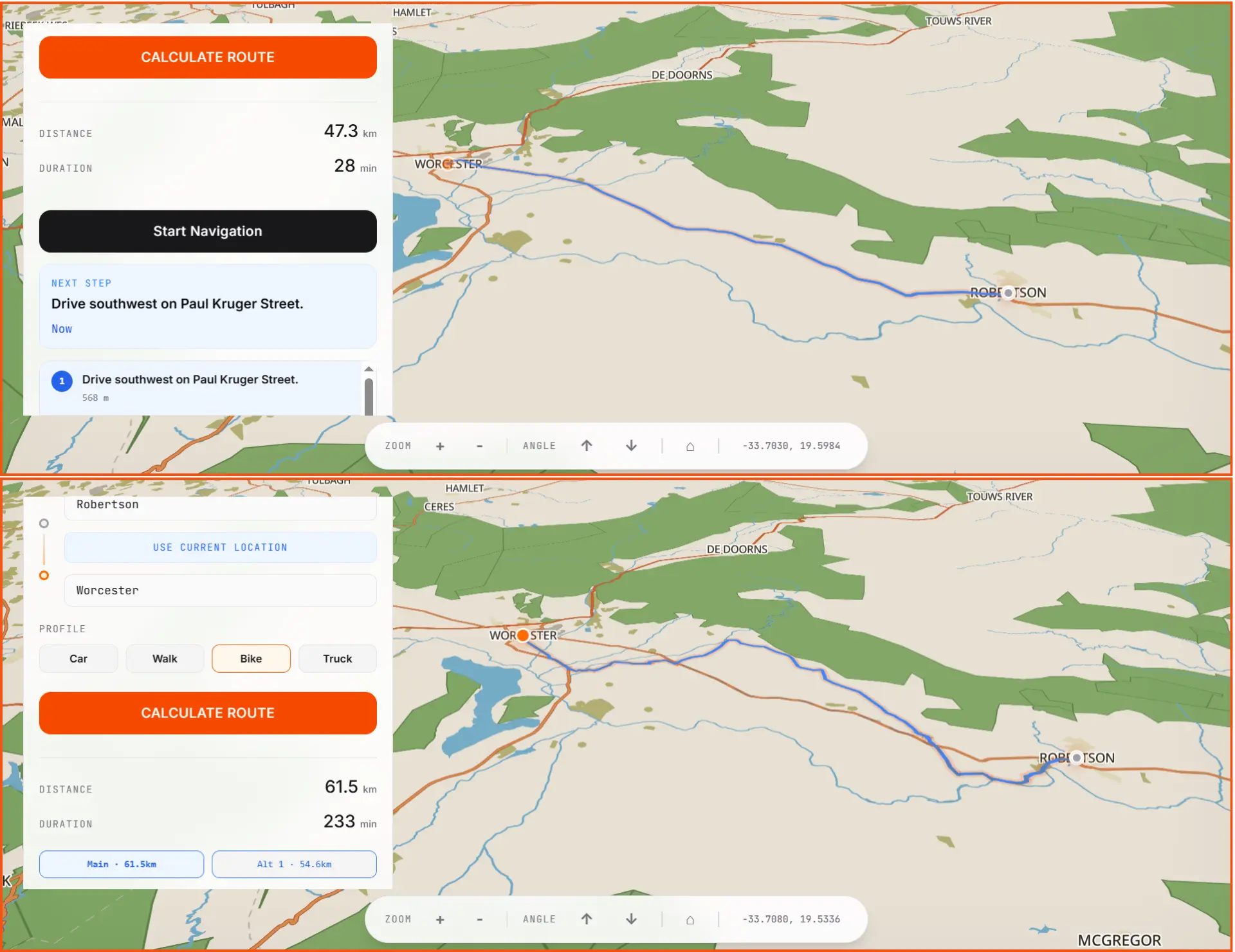
Before the path is calculated, input coordinates are snapped to the nearest routable road segment. This snapping step is important because a GPS coordinate placed inside a building or on a median must be matched to the actual road network before routing can begin.
An OSRM-based routing engine with road graph data derived from OpenStreetMap is a well-known open-source reference for how road-graph routing works. You can also read this practical guide to running Dijkstra’s algorithm on OSM networks to see how travel-time weighting changes the result.
How Does Route Optimization Decide the Best Order for Multiple Stops?
Route optimization tests combinations of stop orders against real road travel times, not straight-line distance, and returns the sequence with the lowest total time or distance, subject to any time-window or vehicle constraints.
Route optimization is not the same as sorting stops by nearest neighbor on a map. Real road networks make the nearest-looking stop sometimes the slowest to reach. A stop across a river might be 200 meters away as the crow flies, but 15 minutes away by road.
Constraints change the answer. A locked delivery window at one stop can force a route that is not the shortest possible distance but is still the best feasible one. A truck profile may avoid roads a car profile would use, and that changes the optimal order.
The response usually includes a savings figure. This number compares the optimized order to the original input order. It gives a direct, quotable proof point for reporting return on investment.
Systems that need the travel-time cost between every stop pair before optimizing often pre-compute this with a Matrix API. An Optimized Route API then uses that cost data to solve the constrained vehicle routing problem with time windows.
Why Does the Travelling Salesman Problem Matter for Multi-Stop Routes?
The Travelling Salesman Problem (TSP) is the mathematical name for finding the shortest possible order to visit a list of stops and return to the start. It matters because the number of possible orderings grows so fast that guessing or manual sequencing almost never finds the fastest route.
With 10 stops, there are roughly 3.6 million possible visiting orders. A driver or dispatcher cannot compare them by eye. Route optimization software solves a real-world, constrained version of the TSP. When multiple vehicles or capacity limits are involved, this becomes the Vehicle Routing Problem.
Manual sequencing tends to follow visible landmarks or the delivery-list order. Algorithmic sequencing follows actual road travel time. The gap between those two approaches is where fuel and hours are lost.
For an authoritative definition of the underlying math, see the entry on the Travelling Salesman Problem. For a beginner-friendly video walkthrough, watch this TSP explained guide.
How Much Time and Fuel Can Route Optimization Save Compared to Standard Routing?
Fleets that switch from manual or unoptimized stop ordering to algorithmic route optimization typically report 10–25% lower fuel costs and 15–30% less drive time, according to multiple published fleet studies.
The fuel savings range is supported by several industry reports and case studies that converge in the same band. The drive-time reduction range is a separate but related metric. Shorter routes reduce fuel directly. Fewer driving hours reduce driver overtime and vehicle wear as a secondary effect.
UPS ORION, one of the most documented large-scale implementations, saves roughly 100 million miles per year across its fleet. That translates to about 10 million gallons of fuel annually. You can read a detailed breakdown of the ORION system and its verified savings in this UPS ORION route optimization case study.
Savings scale with how inefficient the starting point was. A fleet already using rough optimization will see smaller gains than one still planning by hand. Standard routing alone cannot produce these savings because it only measures a fixed path. It does not search for a better stop order.
For more industry data, see this overview of AI route optimization fuel savings and this Verizon Connect analysis of how route planning software cuts fleet fuel costs. Fleet teams evaluating this trade-off can see a fuller cost breakdown.
When Should You Use Standard Routing Instead of Route Optimization?
Use standard routing when there is only one destination, when the visiting order is already fixed by the business (like a scheduled appointment list), or when you only need directions and an ETA rather than a better stop sequence.
Concrete scenarios include a single delivery, a ride-hailing trip, a “directions to store” button, or a driver app showing a route the dispatcher already assigned.
Standard routing is cheaper per request and returns faster. Using it for single-leg trips avoids unnecessary optimization overhead.
Fixed-order routes should stay in a fixed sequence. A scheduled home-visit list confirmed with patients should not be reordered by an algorithm. Optimization would reorder something that is not allowed to move.
When Should You Use Route Optimization Instead of Standard Routing?
Use route optimization whenever a single trip includes three or more stops and the order is not already fixed, delivery runs, multi-site field service, and driver dispatch all fall into this category.
Concrete scenarios include last-mile delivery routes, technician job sequencing, waste and utility collection runs, and multi-patient home visits. Even three or four stops can benefit. The obvious order based on a map glance is frequently not the fastest on real roads.
Optimization is most valuable when it runs on every dispatch event. Daily small routes compound into large fuel and time savings over a year. Logistics operators planning multi-stop delivery runs should treat route optimization as a standard pre-dispatch step, not a monthly planning exercise.
Does Route Optimization Replace Standard Routing, or Work Alongside It?
Route optimization works alongside standard routing, not instead of it. Optimization decides the stop order; standard routing (or the routed legs returned by the optimization response) turns that order into an actual drivable path with turn-by-turn instructions.
A typical dispatch pipeline follows this order:
- Geocode addresses.
- Optimize stop order.
- Route each leg.
- Render on a map.
- Send to driver.
Most Optimized Route APIs already return the routed geometry for the final sequence. A separate routing call per leg is often unnecessary. Understanding both is still useful for building custom flows. For example, you might re-route a single leg after a driver skips a stop.
This is not an either-or purchase decision. It is a “which endpoint for which step” decision. The full navigation API family works this way.
What Is the Difference Between a Route Matrix and Route Optimization?
A route matrix returns travel time and distance between every pair of locations in two lists, without deciding a visiting order. Route optimization uses that same kind of travel-time data to actually choose the best order to visit a set of stops.
A matrix output is an N×M grid, not a sequence. It answers “how long is it from each of my depots to each of my deliveries.” Nearest-depot assignment is a common Matrix API use case.
Matrix data feeds into optimization in two ways. It can assign stops to the closest depot before sequencing. It can also pre-compute a cost table that the solver uses to evaluate stop orders.
A matrix answers “how far is everything from everything else.” Route optimization answers “in what order should I visit these.” This distinction resolves a common point of confusion between three similarly named tools: routing, matrix, and optimization.
What Extra Inputs Does Route Optimization Need That Standard Routing Doesn’t?
Route optimization needs a full list of stops instead of a fixed sequence, plus optional constraints like vehicle costing profile, and whether the route must return to the starting point, inputs that standard routing does not use at all.
The extra fields include:
- An unordered
locationsarray. originanddestination, which may be the same point for a circular route.costingparameters such as auto, truck, or bicycle.- A
return_to_originflag.
Standard routing uses a simpler input: an ordered list of waypoints and a travel profile. It has no time windows and no reordering logic.
Developers migrating from a routing-only integration usually only need to restructure how stops are submitted. They do not need to rebuild their whole booking or dispatch flow.
What Does a Route Optimization Response Include That a Standard Routing Response Doesn’t?
A route optimization response includes the reordered stop sequence and a time-savings figure comparing the optimized order to the original input order, fields that a standard routing response, which only returns one fixed path, does not have.
The extra response fields include:
optimized_locations: the resequenced stops.savings: the time saved versus the input order.- A per-leg breakdown across the whole multi-stop trip.
A standard routing response contains geometry, distance, duration, and step instructions for one path only. It has no concept of savings because there was nothing to reorder.
The savings field is useful to surface directly in a dispatcher UI. It gives a concrete, defensible number for reporting return on investment to a manager.
Which Industries Depend on Route Optimization vs Standard Routing?
Industries with single-destination trips, like ride-hailing or single-package tracking rely mainly on standard routing, while industries with multi-stop operations, like delivery, field service, and fleet dispatch, rely on route optimization layered on top of routing.
Last-Mile Delivery and Logistics
Last-mile delivery depends on route optimization to sequence dozens of daily stops, then on standard routing to turn that sequence into turn-by-turn driver directions.
Daily re-optimization happens at dispatch time. Teams often combine optimization with delivery-zone planning to meet service-level agreements.
Fleet and Field Service Operations
Fleet and field service teams use route optimization to sequence technician visits and standard routing to calculate individual driver ETAs and turn-by-turn guidance between jobs.
Time-window constraints matter heavily for appointment slots. Some teams combine sequencing with a Matrix API to pre-score technician-to-job distance before assignment. Fleet operators can layer these tools into existing dispatch software.
Marine and Offline Navigation
Marine navigation uses standard routing for point-to-point passage planning and benefits from route optimization when a vessel must call at several harbours or checkpoints in one voyage.
Offline routing matters most here because coastal and open-water connectivity is unreliable. Patrol or survey vessels often run circular routes where the origin and destination are the same port.
Emergency Response and Healthcare Routing
Emergency response typically relies on standard routing for the fastest single route to an incident, while healthcare networks use route optimization to sequence multi-patient home-visit runs for nurses and sample-collection crews.
Time-critical single trips favor low-latency standard routing. Scheduled multi-visit runs favor optimization with hard time windows.
Can Offline GPS Devices Run Route Optimization, or Only Standard Turn-by-Turn Routing?
Most offline GPS hardware is built for standard, on-device turn-by-turn routing, since that only needs local map and road data. Route optimization across many stops is typically handled by a cloud API before the trip starts, with the optimized sequence then loaded onto the device for offline navigation.
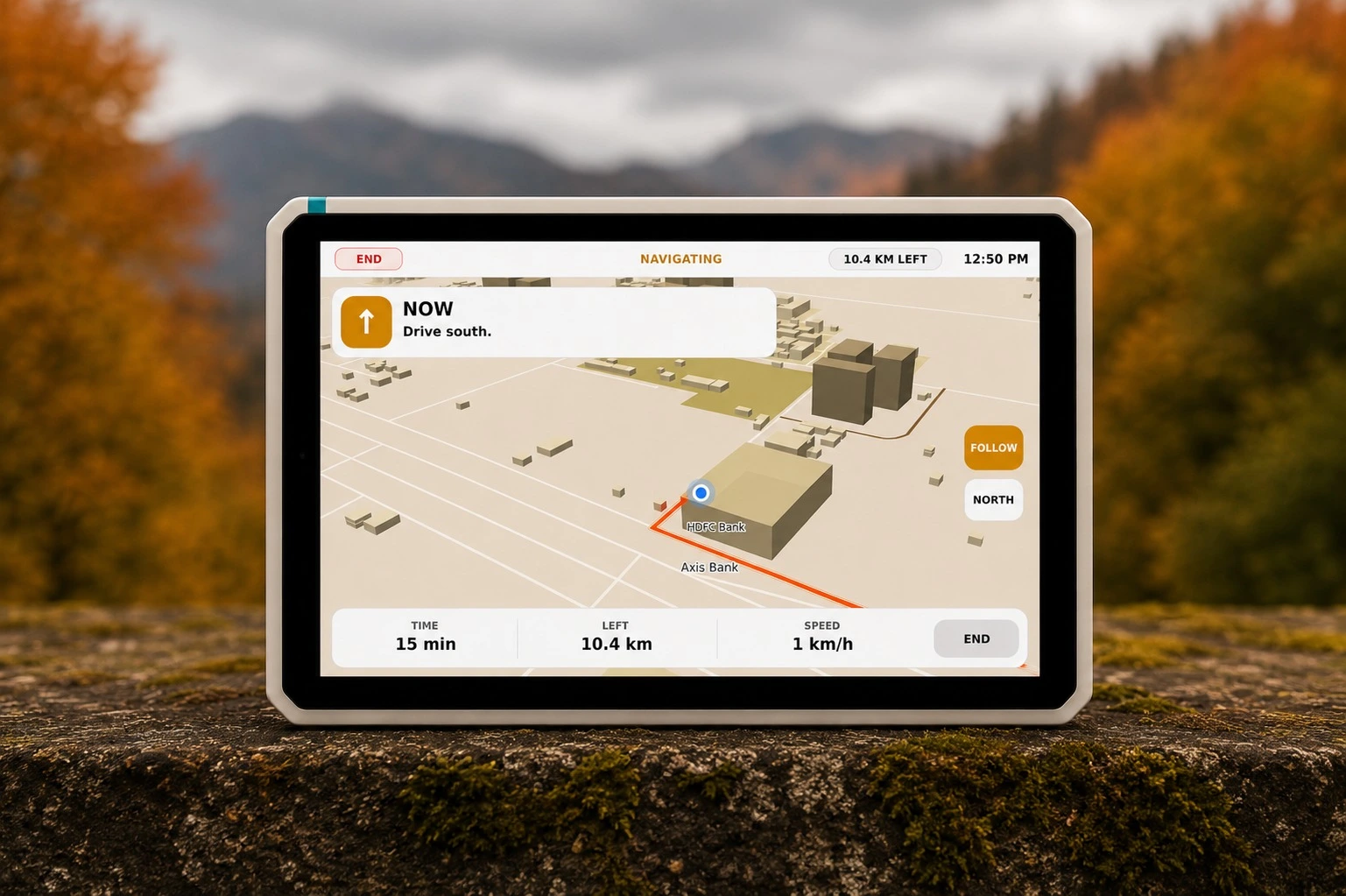
On-device compute is well suited to single-path routing. A shortest-path algorithm can run over locally stored road data without a connection. Solving TSP-style problems for large stop counts is harder to do offline.
Field teams with intermittent connectivity use a realistic workflow. They optimize the stop order while online via an API. They push the ordered stop list and route geometry to the offline device. Then the device handles turn-by-turn guidance with zero connection needed.
This matters for fleets working in rural, maritime, or disaster-response conditions. The optimization step happens before departure, not mid-route. Offline GPS navigators for vehicles and small vessels are designed for this exact split.
How Do You Add Route Optimization to an App That Already Uses Standard Routing?
Add route optimization by inserting one extra step before your existing routing call: send your unordered stop list to an optimization endpoint first, then route (or render) the returned sequence exactly as you already route a fixed path today.
Follow this short migration outline:
- Identify where stops currently enter your system in a fixed order.
- Change that intake to accept an unordered list.
- Call the optimization endpoint before the existing routing or rendering step.
- Update your UI to show the savings figure to prove value to stakeholders.
This does not require replacing an existing standard routing integration. Most systems keep routing for single-leg calculations and add optimization as a pre-step for multi-stop jobs.
A useful testing tip is to run both the old fixed-order route and the new optimized route side by side for a few weeks. Compare total distance and time before fully switching over.
What Mistakes Do Teams Make When Choosing Between Route Optimization and Standard Routing?
The most common mistakes are using standard routing for jobs with many stops (wasting fuel on a suboptimal order), running optimization on every single-destination trip (paying for compute that isn’t needed), and ignoring real-world constraints like time windows when optimizing.
Other frequent errors include:
- Using standard routing for a genuinely multi-stop job. The order stays whatever was typed in. No real optimization happens even though the route looks fine on a map.
- Running full optimization on single-destination trips. This adds unnecessary cost and latency for a decision that does not exist. With one stop, there is only one possible order.
- Ignoring time windows or vehicle-specific constraints. The optimal order on paper becomes infeasible in practice when a truck cannot fit under a bridge or a customer is only home between 2 PM and 4 PM.
- Treating straight-line distance as a proxy for optimization. Real road networks make this unreliable, especially with one-way streets or river crossings.
- Not re-optimizing when conditions change. A stop added, cancelled, or a driver falling behind schedule mid-route all warrant a fresh sequence.
FAQs About Route Optimization vs Standard Routing
Q1: Is route optimization the same as GPS routing?
A1: No. GPS routing, also called standard routing, calculates one path between fixed points. Route optimization decides the best order to visit multiple points before routing them. A GPS gives you directions to one address. Route optimization acts like a dispatcher deciding which 10 addresses to visit first.
Q2: Does route optimization use the Travelling Salesman Problem?
A2: Yes. Route optimization solves a constrained, real-world version of the Travelling Salesman Problem, or the Vehicle Routing Problem when multiple vehicles are involved. It factors in real road travel times instead of straight-line distance. For a deeper look, see this in-depth TSP analysis.
Q3: How many stops make route optimization worth using?
A3: Most teams see meaningful value starting around three to five stops per trip. Manual ordering becomes unreliable well before it becomes impossible. Even a small number of stops can hide inefficient backtracking on real roads.
Q4: Can standard routing handle multiple waypoints?
A4: Yes, but it will not reorder them. Standard routing follows the exact sequence of waypoints you submit. If the order is wrong, the route will still be inefficient.
Q5: Is route optimization more expensive to run than standard routing?
A5: Per-request pricing is often similar, but optimization does more computational work per call. It evaluates multiple possible stop orders rather than one fixed path. Check current API pricing for exact figures.
Q6: Do I need both a routing API and an optimization API?
A6: Most multi-stop dispatch systems use both. Optimization sets the stop order. Routing, often returned within the same optimization response, generates turn-by-turn directions for each leg. The two work together in nearly every production dispatch pipeline.
Which One Should You Choose: Route Optimization or Standard Routing?
Choose standard routing for single-destination trips where the order is fixed or irrelevant. Choose route optimization for any trip with three or more stops where the visiting order is flexible, and expect to use both together in most real dispatch systems.
Use this short checklist:
- One stop, fixed destination → standard routing only.
- Multiple stops, order already fixed by business rules → standard routing only.
- Multiple stops, order is flexible → route optimization, then routing for each leg.
- Building a dispatch platform from scratch → plan for both endpoints from day one.
The next practical step is to try both endpoints directly. Test standard routing in the live demo, or talk to the team about a fleet-scale integration.