GPS Navigator Features

Every critical navigation function,
built into the device.

Maps, routing, search, GNSS, marine charts all running locally on the device. No API key. No cloud round-trip. No signal required.
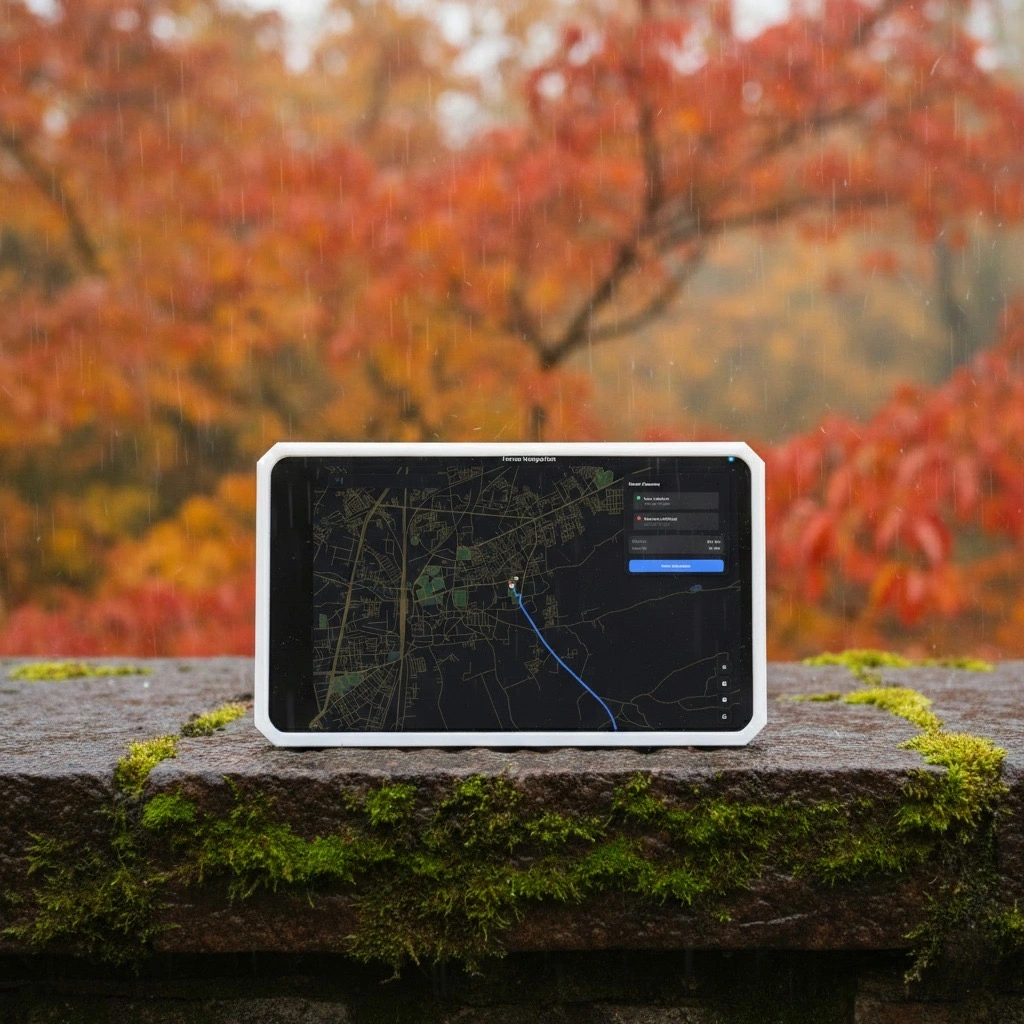
Farun navigation interface

Offline route engine

Maps loaded · GNSS active · route ready

Navigation

Maps, routing, and search that stay on the device.

Farun stores the full navigation stack locally map rendering, POI search, route calculation, elevation context, and isochrone visualisation. The device does not need an API key, a data connection, or a server anywhere in the chain to navigate.

Offline Vector Maps

Roads, terrain, water, buildings, land use, hardware-accelerated rendering at certain zoom levels from local storage.

Turn-by-Turn Routing

On-device route calculation with step-by-step instructions, distance, and duration. Reroutes from current GNSS position when plans change.

Local POI Search

Wide database of points of interest searchable entirely on-device - campsites, fuel, emergency services, marinas, trailheads, and more.

30m Elevation Topo

SRTM-based elevation data for gradient shading, contour lines, line-of-sight estimates, and terrain-aware route planning.

Dynamic Isochrones

Visualise reachability from any point, show which areas are accessible within a given time or distance threshold.

Optimised Multi-Stop Routes

Reorder waypoints for minimum total distance or time, essential for field teams and delivery runs with multiple stops.

Positioning

GNSS-first location for remote environments.

Dedicated satellite positioning gives the GPS Navigator its own independent location source. No mobile tower dependency, no network-assisted positioning fallback. Accurate in dead zones, open water, canyons, and high canopy.

Precision GNSS

GPS, GLONASS, and Galileo constellation support for sub-metre accuracy without network augmentation.

Satellite Lock Status

Real-time satellite count, fix quality, HDOP, and lock status visible on screen and queryable via the local device API.

Heading & Speed Telemetry

Continuous heading, ground speed, and position updates at configurable intervals for navigation overlay and operational logging.

Private by Design

Position data stays on-device by default. No telemetry leaves the unit unless your deployment explicitly configures a sync or export.

Marine

One device for road, trail, harbour, and open water.

Marine mode brings nautical chart layers, tidal predictions, water boundaries, and coastal POIs into the same rugged device with no mode switch required. The Navigator detects water entry via GNSS and transitions automatically.

Offline Nautical Charts

ENC-derived chart data stored on-device. Depth contours, buoys, shipping lanes, restricted zones, and marina PoIs - no chart server required.

Predictive Tide Engine

40-year tidal harmonic dataset covering coastal and inland waterways. Precise high/low tide times for any coastal waypoint, years into the future.

Auto Land ↔ Marine Switch

GNSS detects transition to open water and switches to nautical chart mode automatically. No manual toggle required.

Marine Waypoint Planning

Set and save waypoints, plan multi-leg passages, and calculate leg distances and bearings on the chart view.

Under the hood

Designed for repeatable operations,
not casual trips.

The features above are designed for field teams, fleet operators, marine skippers, and expedition leaders who need navigation to be a reliable system, not an app that might fail at a critical moment.

01

Local Map Engine

Tile rendering, zoom, pan, search, and route overlay run entirely on the device. No tile server, no CDN, no buffering. The map is instant because it's local.

02

Route Recalculation

The routing engine recalculates from the current GNSS position in real time, whether you missed a turn, changed your destination, or the terrain made the original route impassable.

03

Operational Privacy

Trip history, route data, and position logs stay on-device by default. Nothing leaves the unit unless your deployment explicitly configures a sync or data export.

04

Fleet-Consistent Behaviour

Every device in a fleet runs identically same map data, same routing profiles, same POI database. Consistent navigation behaviour across the whole operation.

05

Marine Mode

When you enter the coastal waters, you just change the routing mode to marine mode. The device then switches to nautical chart mode and loads the relevant chart data.

06

Hardware-accelerated rendering

Map tiles render through the device's GPU pipeline, not software rasterisation. This keeps the interface responsive at any zoom level, even with high-density vector datasets loaded.

Honest limitations

What the device does not do.

Live Traffic Data

Real-time traffic conditions require an internet connection and are not available offline. Route calculations use static road graph data.

Real-time Map Updates

Maps are pre-loaded at procurement. Road graph changes and new POIs are delivered via optional annual update bundles, not live.

Voice Turn Instructions

Turn-by-turn routing is visual. Audio navigation prompts are not available in V1.0 and are planned for a future firmware update.

Next step

Match the feature set to your deployment.

Review the full hardware specs, check pricing tiers, or talk to Farun about the map region, marine chart pack, and fleet configuration that fits your use case.